

Nipple covers have one job: to not exist, visually. And the difference between invisible and faintly-outlined-all-night comes down to about ninety seconds of application technique. If you've ever caught a telltale ring under a slinky top in someone's flash photo, this is the guide that makes sure it's never yours.
The Quick Answer
Edges show when a cover goes on cold, creased, or off-center. The fix: warm the cover between your palms for 20 to 30 seconds so the silicone turns supple, center it over the nipple, and smooth firmly from the middle outward so the tapered edge fuses flat against your skin with zero creases. Then press your top's fabric over it briefly and verify with a flash photo. The Original Sticky Boobs ($25) are cut with a feathered, tapered edge precisely so this technique disappears them.
Warm First: Cold Silicone Doesn't Cooperate
Silicone stiffens when cool, and a stiff disc pressed onto curved breast tissue bridges instead of conforming, leaving a raised rim that fitted fabric happily displays. Hold the cover sandwiched between your palms for 20 to 30 seconds, and it turns soft enough to follow your exact contour. This one habit fixes more visible-edge problems than everything else combined. While you're there, confirm the adhesive side is clean and lint-free; a stray fiber under the edge props it up like a tent pole.
Center, Smooth Outward, Never Re-Drag
Placement is a bullseye job: the nipple should sit dead center so the tapered edge lands on smooth, flatter skin all the way around. Press the middle down first, then smooth outward in every direction, the way you'd apply a screen protector, chasing any air toward the edge and out. If you land off-center, don't drag the cover across your skin to correct it; peel it fully off and re-place, because dragging concertinas the edge into micro-creases that read as a ring under thin fabric. Size matters here too: the edge must clear the areola and land on flat skin, so if it sits on curved tissue, go up a size (they run Cup A to B, B to C, and C to D+), and match your shade (Light, Tan, Dark) if the fabric is pale or thin, since a color mismatch shadows through even when the edge is perfect.
The Full Invisible-Edge Routine
- Start with clean, dry, lotion-free skin; even day-old moisturizer softens edge grip and invites lifting later.
- Warm the cover between your palms for 20 to 30 seconds until it flexes easily.
- Center over the nipple, press the middle, then smooth outward in all directions with firm fingertips.
- Run a fingertip around the full perimeter, feeling for any lifted or creased section, and re-smooth it flat.
- Put the top on, then press the fabric gently over each cover for a few seconds so fabric and silicone settle together instead of catching.
- Take a flash photo in your actual outfit, front-on and from each side; flash exposes edges and shine that mirrors hide.
- Spot a shadow line? Peel, re-warm, re-apply; it's ninety seconds well spent.
Where Even Perfect Technique Loses
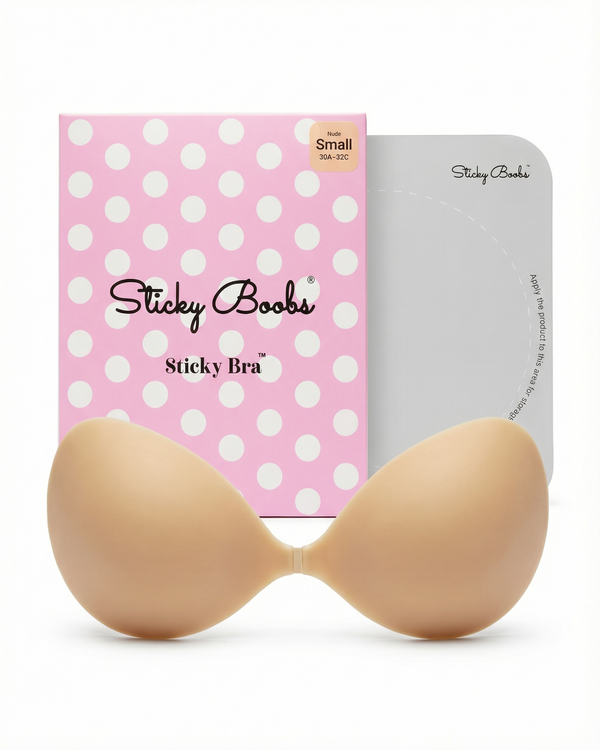
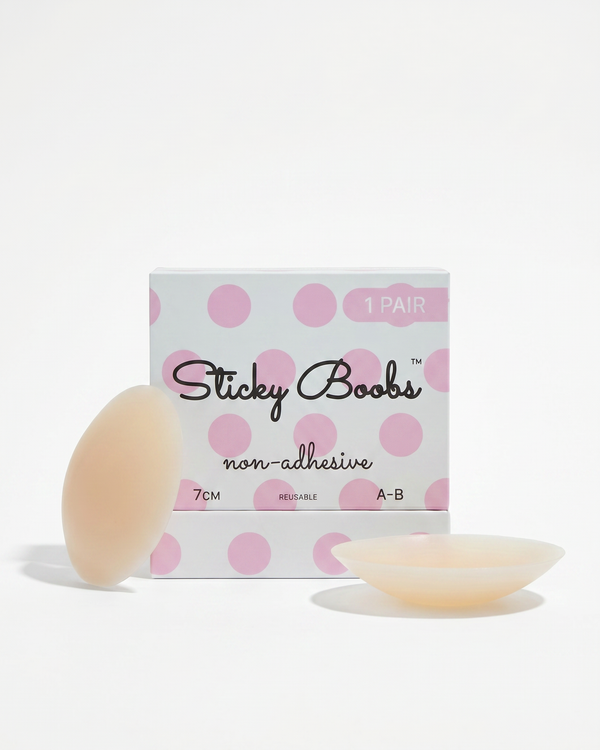
Full honesty: some fabrics defeat everyone. High-shine liquid satin and ultra-stretched thin lycra map every contour on your body, cover or no cover, and the fix there is a fabric-level one (a lined version of the top, or a slip). And remember covers smooth but don't lift; if the top also needs shaping, that's a Sticky Bra ($35) conversation. For all-day comfort or reactive skin, the Non-Adhesive covers ($25) apply the same way minus the adhesive, held by a snug layer instead.
FAQ
Why can I see the edge of my nipple covers through my shirt?
Three usual causes: the cover went on cold and stiff so the edge never fused flat to your skin, a crease or air bubble formed during application, or the cover is too small and its edge lands on the curve of the areola instead of flat skin. Warm the cover, smooth from center outward, and size up if the edge sits on curved tissue.
How do you make nipple covers completely invisible under clothes?
Warm the cover between your palms for 20 to 30 seconds, center it over the nipple, and smooth outward in all directions so the tapered edge fuses to the skin with no creases. Then press the fabric of your top over the cover for a few seconds so the two settle together, and check with a flash photo.
Do nipple covers show more under tight or loose clothing?
Tight, thin, and shiny fabrics show edges most, because stretched fabric maps every contour beneath it; think slinky jersey, satin, and anything with lycra sheen. Looser weaves, textured fabrics, and prints hide covers almost completely.
What is the flash photo test for nipple covers?
Take a phone photo of your chest with the flash on, in the top you're actually wearing, before you leave. Flash flattens shadows and reflects off raised edges and shine, revealing outlines a mirror in soft bathroom light will never show, and it's exactly what event photography will do to you later.
Warm, center, smooth, flash-check: do those four and The Original Sticky Boobs vanish the way they're supposed to.
Not sure which one your outfit needs?
Take our 60-second quiz and get matched to the right sticky bra, nipple covers, or boob tape for your exact dress — then shop it in a couple taps.